
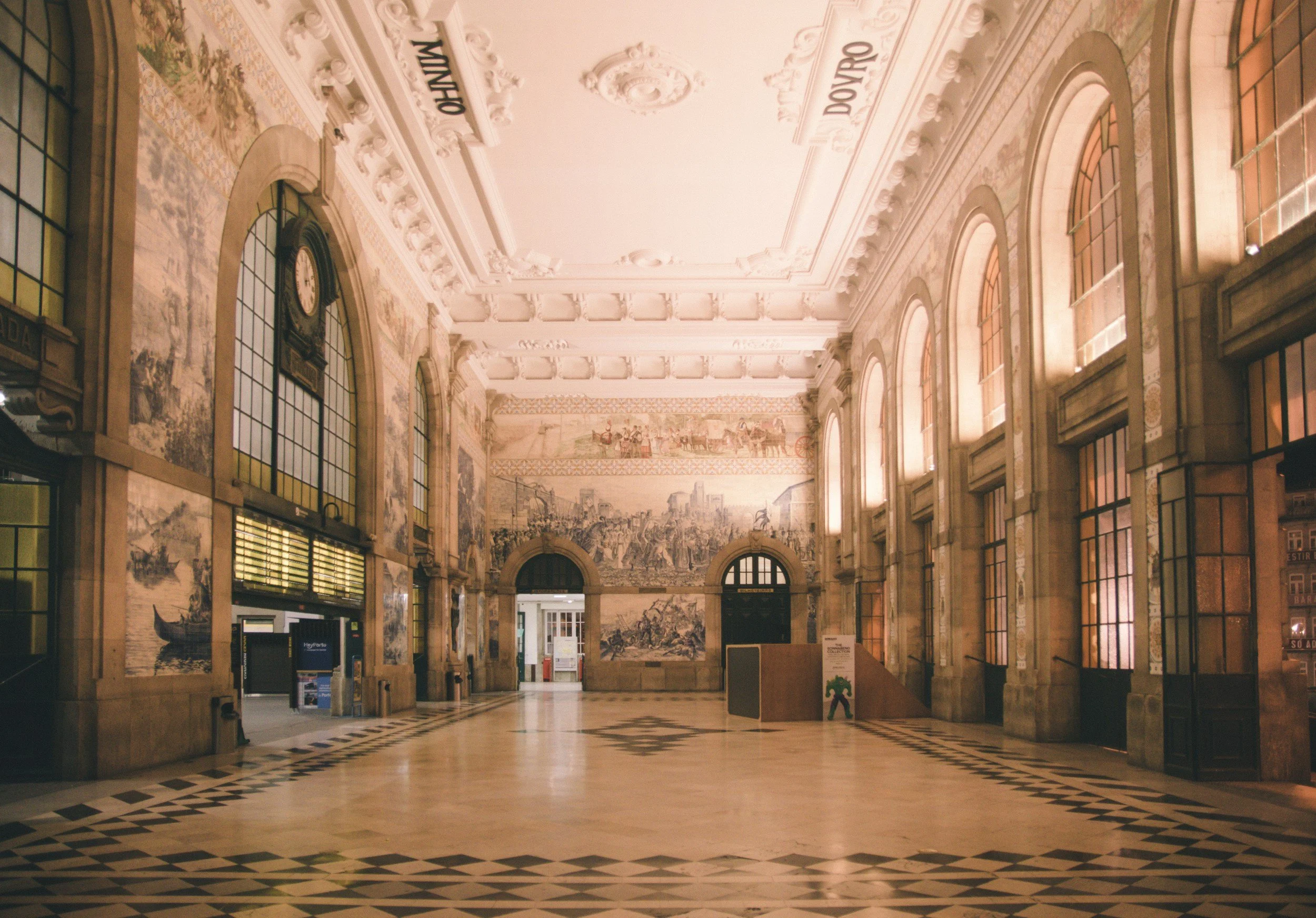
São Bento is a place to look up, slow down and notice the details. Beyond its role as a railway station, its entrance hall offers visitors a striking introduction to Portugal’s tradition of painted ceramic tiles, known as azulejos.
You do not need to build an entire day around the visit. A short, attentive stop can be a memorable part of exploring central Porto, especially if you give yourself time to look beyond the first photograph.
Start with the hall as a whole
Before studying an individual scene, take a moment to see how the decoration fills the space. Visit Portugal describes around twenty thousand pictorial tiles in the entrance hall, created by Jorge Colaço. The panels bring together historical subjects and images of regional life.
Stand somewhere that leaves the main circulation routes clear, then let your eyes move between the larger scenes and the smaller details. Notice the way separate tiles form a continuous image, and how the scale changes when you view a panel from further away.
Look for the story above the panels
There is more to see than the large blue-and-white compositions. A coloured frieze runs around the atrium and traces the development of transport, leading towards the railway age. Below it, the larger panels depict episodes from Portuguese history.
This gives you a simple way to explore: look at the upper decoration first, then choose one larger panel to examine. You might notice a gesture, an animal, a building or a piece of clothing that was easy to miss at first glance.
Notice the architecture too
The station’s original design was the work of architect Marques da Silva. Its foundation stone was laid in 1900 on the site of the former convent of São Bento de Avé Maria, according to Visit Portugal.
Alongside the tilework, pay attention to the proportions of the entrance hall, the openings and the relationship between the decorated walls and the rest of the building. These details can help you appreciate the space as architecture rather than only as a backdrop.
Remember that this is a working station
People are passing through to make journeys, so keep entrances, information points and routes towards the trains clear. Avoid stopping suddenly for photographs or spreading a group across a busy passage. Follow signs and any instructions from staff.
If the hall feels crowded, keep your visit brief or consider returning at another time. There is no guaranteed quiet hour, and a shorter stop can still give you time to appreciate the tilework.
Keep the rest of your outing flexible
Choose your next stop according to your energy and interests. A nearby pause may be more enjoyable than adding another landmark immediately. Check the route back to your accommodation, particularly if steps or slopes affect how comfortably you get around.
For more ideas, read our rainy-day Porto guide or explore Porto at your own pace. Both offer ways to enjoy a city break with room to pause.
Historical reference: Visit Portugal: São Bento station. Check current visitor arrangements and local signs when you arrive.
